Run agents in parallel.Break nothing.

Hivemind orchestrates multiple AI coding agents in parallel. Each one is locked to specific files. Anything outside its scope gets rejected before it lands — and nothing reaches your branch until you click ship.

Desktop app Bring your own Codex or Claude Code Windows today

THE PROBLEM

Everyone says they review every diff. Nobody does.

Agents that read your code, write your code, and decide what to do next all share one context window. The code crowds out the reasoning and long jobs fall apart. Bigger context windows just delay it.

“Review every change” is a promise, not a mechanism. It works until you’re tired, or busy, or the diff is 400 lines. Then it doesn’t.

Hivemind doesn’t ask you to be careful. It makes carelessness harmless.

WHY MORE AGENTS FORGET

More agents do not fix forgetting.

Ultra mode and “spin up subagents” give one AI more hands. The same overloaded AI still has to remember what every worker is doing, keep the original request straight, and decide whether the result actually works.

01 / CONTEXT ROT

It forgets what it decided.

One AI plans, reads code, spawns workers, reviews output, and keeps every result in one conversation. Code and logs crowd out the reasoning. Compaction shortens earlier constraints into summaries, so it can lose decisions it made only a few turns ago.

Hivemind gives each worker a smaller task context instead of one conversation that has to remember everything.
02 / FOUND LATE

You notice after it spreads.

Wrong work can look finished, so more tasks build on top of it. By the time a human discovers the missing behavior, other changes depend on the mistake and the repair is much larger.

Hivemind stops failed work before it becomes the next task’s foundation.

HOW IT WORKS

Three agents, three jobs.

01

A planner that never reads your code

It breaks your request into tasks and tracks everything on disk, so it isn’t holding your codebase in its head. But it was still asking a model what to do next at every step — 178,000 tokens a run to pick moves that were already determined. Take the lock, open a worktree; there’s one legal next step and no judgment in it. That part is plain code now. The model only plans, listens to you mid-run, and decides what to do when something breaks. 11 fewer model calls, 50%+ fewer tokens.

02

Two agents can’t touch the same file

Each agent gets its own copy of the repo and a list of files it owns. Simple — except the first version of that lock could be stolen. If the operating system said ‘permission denied’ instead of ‘no such process,’ the code assumed the other agent was dead and took its files. Three separate ways that could happen. Now anything ambiguous means the other agent is alive and nothing gets taken. 55 seconds of real overlap on a two-task run, same token cost, a third less waiting.

03

One click to ship

For a while the button lied. It said Merged. Nothing had merged — shadow verification builds your changes on a throwaway branch and deletes it, and the app was reporting the rehearsal as the real thing. My main branch sat at the same commit while the interface told me the work had landed. Now Merged appears only after the branch has moved and the app has re-read git to confirm it. What it tells you is checked against the repository, not against what it hoped happened.

INSIDE

The app itself, unretouched.

Every screenshot below is the build that runs today.

01Plan02Run03Ship
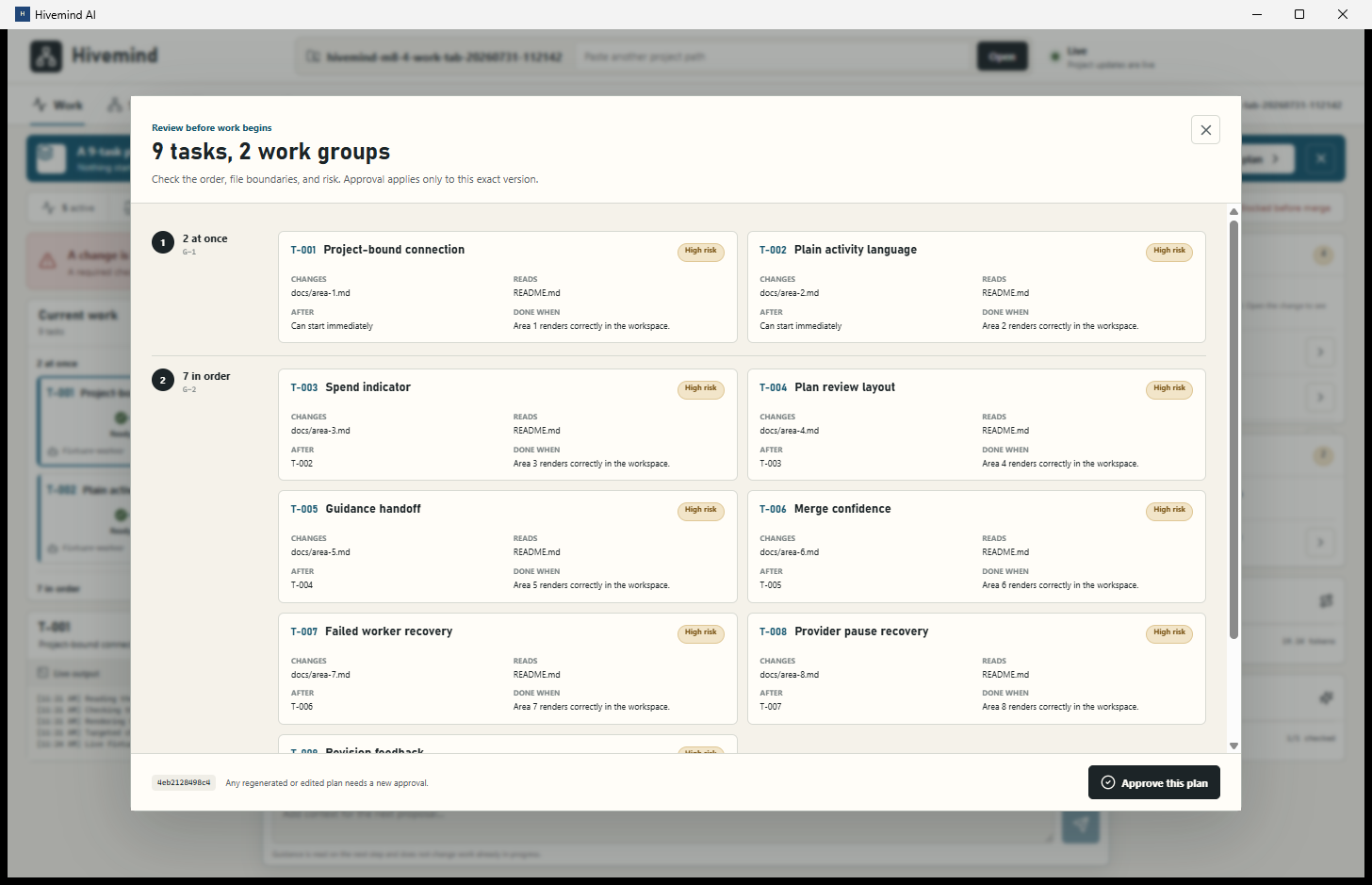
Hivemind plan review showing nine tasks, work groups, and file boundaries before approval
01What it’s about to do — the plan, with file boundaries, before anything runs
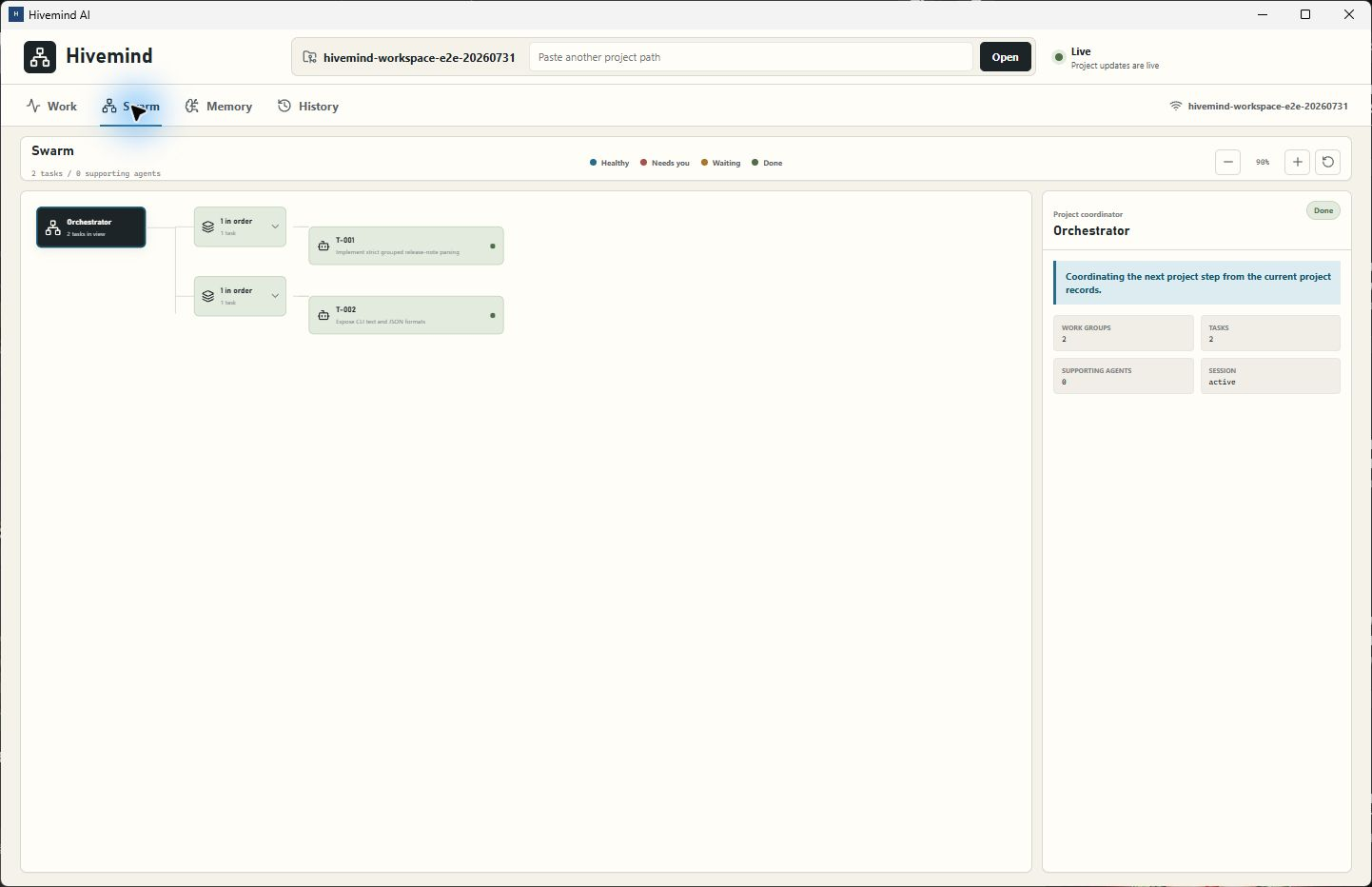
Hivemind Swarm view showing the orchestrator, two work groups, and their tasks
02Every agent at once — the whole run on one screen, colour-coded by state
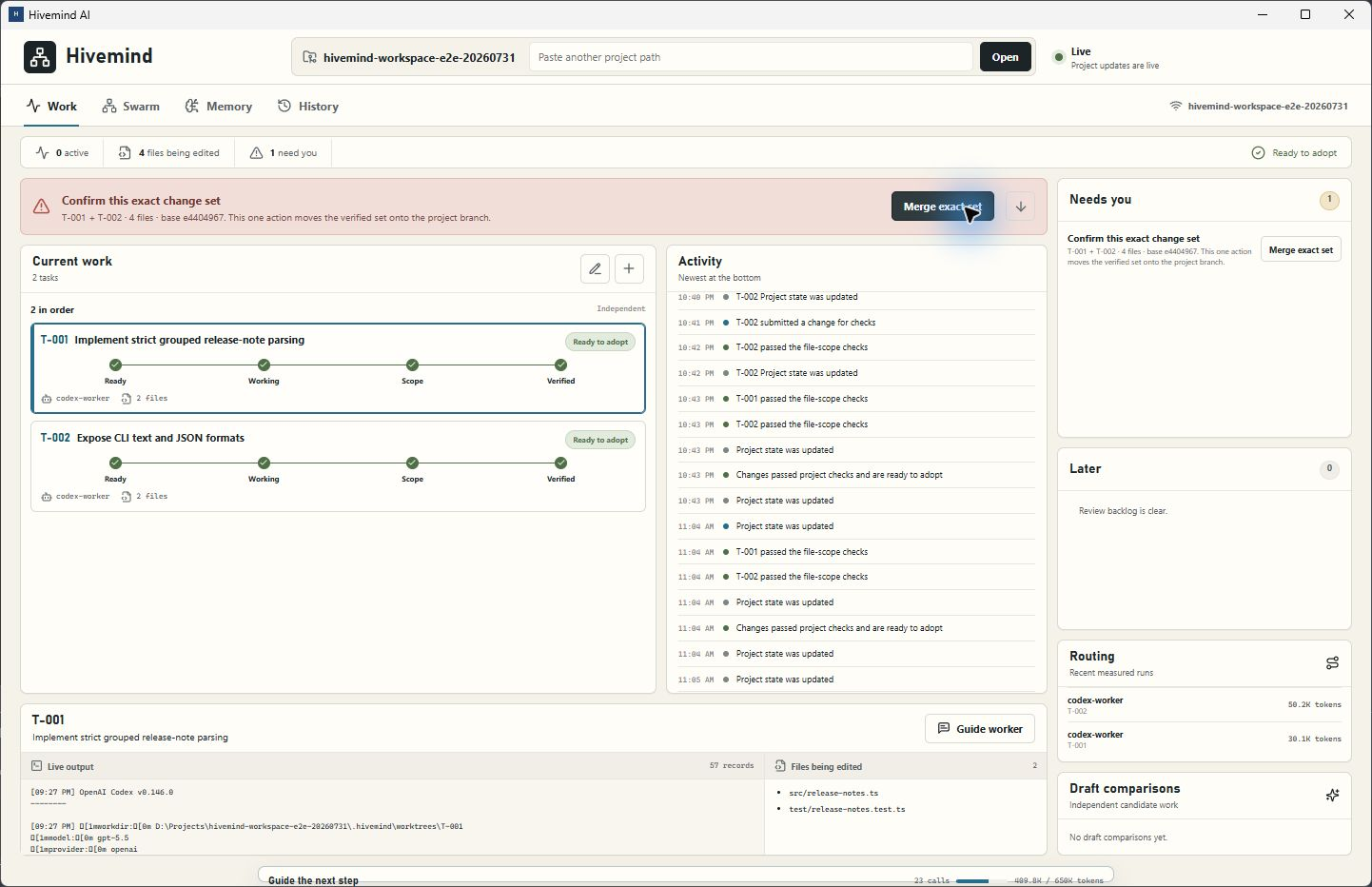
Hivemind Work view showing two verified tasks and the exact change set ready to merge
03One click to ship — what changed, what passed, and nothing else asked of you

WHAT IT PREVENTS

A real agent tried to lie to me.

One of my agents was told to build a command-line tool that takes an --input flag. It built something else entirely, wrote its own tests for its own wrong version, and passed all nine. Every check was green.

This happens more often than anyone realizes: an LLM can build a convincing skeleton, test the skeleton, and only reveal the missing behavior after other work depends on it. Hivemind checks the original spec independently before the agent’s own tests run. An agent can prove its implementation is internally consistent; it cannot quietly redefine what success meant.

The dangerous failures are the ones that look done.

The blunt answers.

FAQ

Do I need to know how to code?
No. You describe what you want and click ship.
Do I have to read the diffs?
No. That’s the point. They’re there if you want them.
Does it use my own AI subscription?
Yes — bring your own Codex or Claude Code. Nothing is resold.
Is it faster than one agent?
Independent tasks run in parallel. Measured about a third faster on a two-task run — bounded by your longest task.
Does parallel mean it burns through my usage?
Not automatically. One long-running agent spends tokens carrying and reconstructing the same swollen history after compaction. Hivemind splits independent work into smaller contexts. Badly split work can still cost more; parallelism is not free.
Is it cheaper?
Yes, on simple work — measured 54.7% cheaper per task by routing cheap models to easy work, verified across 30 runs. I haven’t benchmarked against using Codex directly yet.
Is it finished?
No. It runs end to end today on Windows. This is a waitlist, not a launch.
Who’s building it?
Ethan, 14. I’ve been vibe coding since Claude 3.7 Sonnet. This is the first thing I’m shipping.